
December 30, 2025
2025 Year End Review and Market Outlook
In many respects, 2025 was a year that set the stage for significant structural changes in the world’s economic and financial architecture. The Trump administration’s focus on rebalancing world trade and re-shoring strategically critical manufacturing sectors is expected to cause what the US Treasury Secretary calls a “grand reordering” of the global economic and financial system.
After decades of globalization, cheap capital, and low inflation, we are now transitioning to policies that emphasize national security and resilience. This means fragmentation of supply chains, to ensure critical raw materials and finished goods are produced domestically or sourced by allied nations, albeit at higher costs. It also means more emphasis on real economic production, where productivity, skilled labor, and abundant energy matter again. Re-shoring critical sector manufacturing and shipbuilding will require tremendous amounts of new infrastructure investments. Demand for capital investments will obviously make capital expensive again, which will require spending discipline, otherwise profit margins will disappear. Debts and deficits will matter again both on business and national level. Sourcing raw materials and finished goods dependably, cost of capital, trade restrictions, and currency values will be even more important in what seems to be a more adversarial world.
Tariffs, once seen by the western world as the enemy of free trade, are now seen as an important national security tool used to rebalance and promote fair trade. Notice the change in emphasis from “free trade” to “fair trade”, introduced by the US administration. Western leaders initially criticized the Trump administration for disturbing the established order by commanding a trade rebalancing. By the end of the year however, the colossal $1.2 Trillion Chinese trade surplus with the world must have changed their minds. Germany, France, and even Mexico, are all imposing or threatening to impose tariffs on Chinese made goods. The world is getting tired of China exporting its problems to other countries and is ready to take action. Low prices of Chinese made goods are not helpful to workers who lose their jobs because their employers cannot compete.
In the US, the introduction of tariffs on April 2nd (Liberation Day) sparked fear that prices would increase, inflation would get out of control, and consumer spending would suffer. The stock market promptly declined 20% in a week but also recovered quickly once the tariffs were postponed for several months. Market participants understood that tariffs were mostly a negotiating tool used to jolt the world governments to address the humongous Chinese trade surplus, which is their trade deficit. If all goes as planned, tariff revenues should decline over time, while income and payroll tax revenues from new manufacturing jobs should increase.
Future job creation, new infrastructure investments, and optimism about more monetary easing from the FED boosted investor confidence enough to drive the S&P 500 index 16+% higher for the year (as of this writing). While a double-digit increase in the S&P 500 index seems great, higher stock prices do not mean safer, and it certainly doesn’t mean that investors will realize a return on their investment. US stock prices currently remain elevated, and in our opinion, many stocks are overpriced given the earnings these companies produce. For instance, the S&P 500 ‘Shiller Price-to-Earnings’ ratio currently exceeds 40x (the average is 16x), the stock market capitalization-to-GDP ratio (also known as the Buffett indicator) is currently 2.19x (the average is 1x), institutional portfolio cash balances are down to 3.3% (extremely low levels of liquidity), while margin debt balances (investor borrowed funds) are at a record high $1.23 Trillion. Needless to say, investor sentiment is extremely optimistic. **Such metrics suggest caution! **
Many things must go right in the future for stock prices to remain this high. Historically, when the ‘Shiller PE’ ratio and the ‘market capitalization-to-GDP’ ratio reach such levels, the following ten-year annual stock market returns are very low. This suggests some profit taking is not a bad idea at these record-high prices. Here at FFG, we like to harvest profits throughout the year by closing positions that have exceeded our profit targets– capturing these gains is a prudent (and disciplined) way to generate investment income.
No one knows exactly when the stock market will make a correction and erase some of the paper profits (unrealized gains). Oftentimes, investors fall victim to the idea that prices will go even higher, and by selling to capture profits they could lose potential upside. Sure, prices can always climb higher, but investors only know the top is in after the market suffers a significant decline. By then, lots of paper profits (unrealized gains) will have evaporated. One of Warren Buffett’s famous lines is that he “always sold too early”. Nevertheless, he seemed to do just fine…
Look for example at the recent investor behavior with respect to the precious metals price action. The gains of precious metals have humbled the gains of the stock market this year. As of this writing, Gold is up more than 60% for the year, silver is up more than 160% just since April, and now platinum and palladium have also joined the euphoric party. At first glance, such parabolic price movements are explained by media pundits as a “return of the inflationary 1970s”, which brought monetary easing and resulted in fiat currency credibility erosion. However, the recent data from the US and Europe point to stable inflation rates between 2% and 3%, and weakening labor market conditions which are typically followed by price declines. Fortunately, this is not the 1970s redo the media is claiming. Yes, there are industrial uses for silver, platinum, and palladium, and yes, there are supply deficits, but the parabolic price moves cannot be explained by minor supply-demand imbalances. Furthermore, stock prices **and **precious metal prices have both rallied simultaneously, which is an unusual event as higher inflation expectations typically push metal prices higher while hurting stock prices.
The more reasonable explanation for these wild price swings is the $1.2 Trillion Chinese trade surplus. In previous years, the Peoples Bank of China (PBOC) would buy US Treasury and European bonds with that surplus to prop up its trading partners’ currencies while keeping the Chinese Yuan cheaper, which promotes further exports to these countries. This time around, since the Trump administration tariffs ushered in a more adversarial relationship with China, the PBOC has been using its enormous trade surplus for precious metals purchases instead. Investors who believe the price surge in precious metals is due to the ‘death of fiat currencies’ or ‘industrial demand’ are concluding that the shift in metal demand is permanent and irreversible. While no one can tell the future with certainty, the more likely scenario is that investors who don’t capture profits from their metal holdings soon could see their paper profits (unrealized gains) evaporate when the inevitable correction in precious metal prices comes.
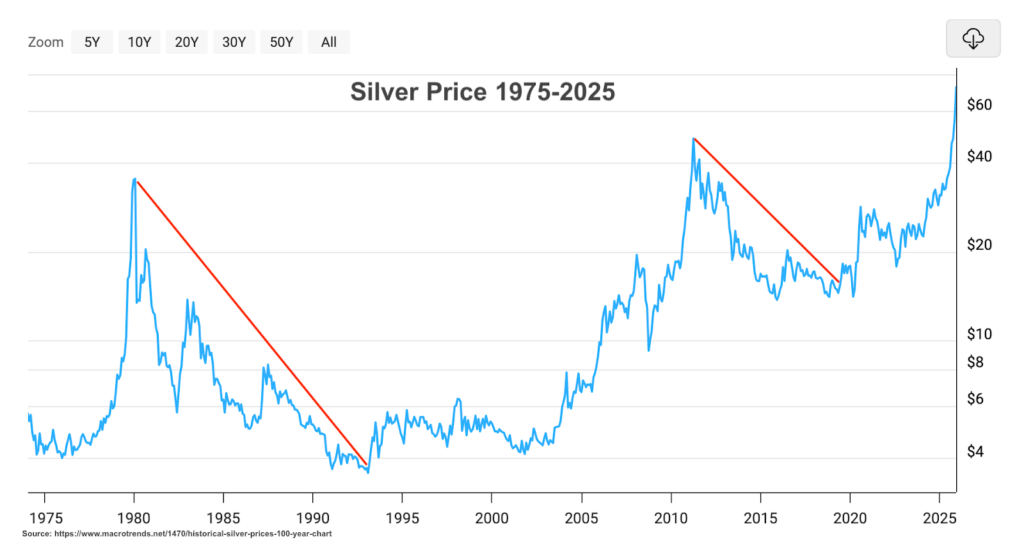
Speaking of corrections, the prices of precious metals have a nasty habit of declining by 50% or more and staying in correction mode for decades (please see the graph below). There could be several reasons for the start of such a correction. For example, the PBOC may decide to buy something else with their trade surplus funds, or the surplus size could shrink as countries impose tariffs on Chinese made goods, or governments could impose restrictions on metal exchanges. In the past, major economies like the US, UK, Australia, and India have all imposed restrictions on precious metals transactions (or outright confiscation), which lasted decades and demolished the prices. Investors chasing “safety” where there is none may be better off capturing some profits from their precious metal investments, while the record-high prices are still around. It is never a good idea to underestimate the reach of hungry over-indebted governments.
–
–
Looking forward, here are a few of the developments we are monitoring closely, and how they can affect the markets in 2026:
Company profits: In late January and early February, we’ll get the fourth quarter (2025) corporate earnings reports. For stock prices to remain high and possibly climb higher, we’ll have to see some amazing profits posted. Short term sentiment and excitement can certainly move the market, but profits are the “mother’s milk” to stock prices.
**Liquidity: **This is the tailwind that any high-flying market needs. The Fed has lowered the Federal Funds rate to 3.5%-3.75% and started some “reserves management” action by purchasing $60 Billion T-bills per month ($40 Billion in new money plus $20 Billion from maturing Mortgage-Backed Securities). As we wrote in our last newsletter, we were expecting some FED action to boost liquidity because the REPO market (where banks borrow from each other) was drained. Banks refusing to lend to other banks indicated a high level of liquidity stress and the FED had to act. This is not exactly Quantitative Easing (QE) where the FED buys long maturity T-bonds, but in a way, it functions as indirect QE. If the FED buys short-term T-bills, the Treasury will need to sell fewer long-term T-bonds, which can keep long-term rates lower. If the FED engages in outright QE however, that will be a “buy” signal to go into stocks and other hard assets.
Federal Deficits: In 2024, the federal deficit was $1.8 Trillion. For 2025 the expectation was for a $2.1 Trillion deficit, but it actually came to $1.78 Trillion. Maybe some of the tariff revenue helped keep the deficit smaller. Federal spending is juicing the economy and it is also juicing the stock market. At some point however, the accumulation of deficits will eventually push the current $38.5 Trillion US federal debt to become $50 Trillion debt. The speed of reaching that figure matters, as it will determine whether government spending boosts the stock market or causes a bond market revolt. The US has been enjoying the equivalent of an unlimited platinum credit card (having the reserve currency of the world), allowing it to borrow cheaply because the world trusts the US more than other countries. Policy and geopolitics can erode this trust, raising the US funding costs. The US privilege is not permanent, and the bond market is paying attention. We must watch the 10-year Treasury interest rate, currently at 4.13%. Will it drop closer to 3.7% (world confidence is still there, mostly good for US stock prices) or will it rise closer to 4.7% (bond markets revolting, usually bad for US stock prices)?
Private Credit Losses: Private Credit (PC) funds lend to companies that banks would otherwise not lend either due to low credit quality of the borrower or large loan size. According to the FED, PC funds hold $3 Trillion in loans to companies, which may not be able to even make interest payments, let alone repay the principal. 47% of these companies are leveraged at 5.6x Revenues! This is equivalent to a household with only $100k income but $560k in high interest debt. The borrowers cannot service the debt. These PC funds are amassing substantial losses from borrower defaults and bankruptcies. They are pretending everything is fine, just a few ‘isolated’ defaults, “Nothing to see here”. But we disagree. These “isolated” defaults do not seem so isolated. Company bankruptcies are public records and so are the PC disclosures of accepting “payment in kind” from their borrowers. This means the borrowers cannot make cash payments, so they agree to borrow more from the PC to cover the payments due. For example, KKR (a private lender) has a PC fund which disclosed that 14.4% of the fund income was derived from “payments in kind” rather than cash owed to the fund. These are pure accounting gimmicks to avoid recognizing losses. Unfortunately, due to lack of transparency in the Private Credit world, we do not know the exact size of the losses, but given the $3 Trillion in loans, even a 10% loss will cause $300 Billion of losses to investors. Some of these investors are banks and insurance companies who are exposed, which is how contagion spreads to the financial system and potentially causes a debt crisis. As with all credit crises, lending tightens up and interest rates rise (usually bad for stock prices).
Household Loan Delinquencies: Consumer spending is still surprisingly robust, but the cracks show up in loan delinquencies. There are 7.1% of credit card loans 90+ days late, 6.65% of car loans 60+ days late, and 14.3% of student loans “seriously delinquent” with wage garnishments commencing. Meanwhile, there were 1.1 million layoffs announced during 2025, the highest since 2020. If consumer spending weakens, the economy will slow down (which is usually bad for stock prices).
Japanese Carry Trade Reversal: For more than two decades, the Bank of Japan (BOJ) kept interest rates at the zero bound, flooding the markets with cheap money. Institutional investors borrowed cheaply in Japan and invested abroad where returns were higher. Now, the BOJ seems to be changing its policy and raising interest rates. The 10-year Japanese government bond is paying a bit above 2%, so the spread between the US 10-year and the Japanese 10-year government bond rate is down from 4% to 2.1%. At what point does the spread not justify the risk of carrying loans denominated in Yen? When this happens, US investment holdings will be liquidated to repay the Japanese loans. We must watch the path of the 10-year Japanese government bond rate. Moving much higher than 2% could be dangerous for US stock prices.
In this market environment, we recommend balanced portfolios comprised of some reasonably valued stocks for growth, some Treasury bonds for income and stability, and some cash for flexibility to pursue new opportunities. We also recommend regularly harvesting some of the gains of profitable positions, while letting other positions mature and potentially grow higher. “Cut the flowers, and water the seeds”.
With current prices of some commodities drastically elevated, we do not recommend chasing precious metals. We believe oil could be the comeback story of 2026. Also beef and natural gas look more promising than other commodities. The US cattle head count is at a 71-year low, essentially at the same level as in 1954 when the US had half the population it has today. We like these odds better than chasing after parabolic moves and crowded trades.
We also recommend avoiding Office Commercial REITS, as well as avoiding regional banks that could be exposed to commercial real estate. The losses from this sector have not been washed out of the system yet. A reckoning could be coming to commercial real estate investments and the losses will have to be recognized one way or another. Nothing short of the FED lowering rates back to 0% and turning to full QE will postpone the reckoning. Additionally, we recommend avoiding casual restaurant chains, which have expanded aggressively post Covid. They have high fixed costs (leased properties) and very thin margins. Any consumer spending slowdown will quickly turn these chains unprofitable. We are also very cautious towards the travel industry and particularly the cruise lines. They have expanded capacity significantly with new luxury vessels right at the time consumer spending seems ready to fold. Rising oil prices would certainly hurt the cruise lines and the airlines. Finally, we continue to recommend against most of the overvalued AI infrastructure data center builders. At these high valuations, along with the high production costs in the US, there is very little chance these operations can be profitable.
2026 will see a new FED Chair in May, who will most likely commit to easing monetary policy. Higher tax refunds from the new tax cuts will support household income and spending around March and April (as long as unemployment does not rise significantly). So, there are some potential tailwinds for the stock market after the first quarter. Although, we wouldn’t be surprised to see a much-needed market correction before these tailwinds kick in and carry the market to the November midterm elections. It would be a great opportunity to have a healthy market correction early in the year, before the new FED Chair takes office. That’s when cash balances could be deployed with much higher odds of success.
Our disciplined approach of value hunting has our shopping list ready with potential opportunities. The only missing factor is the right price. Maybe we will get a chance to go shopping early in 2026…
We hope you have a Healthy, Happy, and Prosperous New Year!