
September 1, 2025
Fantasy is Easier Than Reality
Living in fantasy is undoubtedly much easier than reality. Movie studios consistently produce sequels of superhero movies because they are the low-risk, high-profit choice. From Avengers to Transformers, and from Superman, Batman, Spiderman, even Aquaman, people would rather dream of being any type of mutant with superpowers than themselves.
The digital gaming industry is booming, attracting not only children and teenagers but also young adults. Unfulfilled with their real lives, these individuals turn to Xbox (Microsoft) or PlayStation (Sony) gaming consoles to transform themselves into football and basketball stars. Online and with minimal effort, they team up with friends or strangers, experiencing the athletic achievements of professional athletes who have dedicated their lives to crafting their skills. For those gamers seeking more adventure, they switch games and join a special forces unit, “fighting” enemies from their comfortable gaming chairs. With no effort, training, or skill required, they enter the battlefield, where pain and suffering are nonexistent. They simply click START again to get another life and another chance for success. It’s evident how impossible such things are in real life, making fantasy the preferred option for this crowd.
Dreaming doesn’t end there. Parents invest a significant amount of time and money in pursuing their dreams of having talented children. Whether it’s sports or arts, little John and Jane are chauffeured to multiple practices daily or weekly, with no expense spared. From the finest sporting gear or musical instruments to traveling for tournaments or recitals, the parents’ dreams and hopes justify the expense. Having talented children allows them to live vicariously through them, so no sacrifice is too great to prevent parents from fantasizing. However, reality often sets in, and most parents eventually come to terms with the fact that their offspring won’t be the next Michael Jordan, Lionel Messi, Tiger Woods, Serena Williams, or Caitlin Clark. After all the time and money spent, the child may not even make the Middle School team or band. A stark reminder that real life can be a harsh and unforgiving place.
Not surprisingly, people tend to follow similar patterns in their investment decisions. They dream of “striking it rich” and achieving financial success in a single year rather than consistent and disciplined investing over a lifetime. Warren Buffett’s (Berkshire Hathaway) teachings of patient investing in reputable companies with fair valuations are not appealing to many investors. They perceive him as too old and believe his investing philosophy is outdated, citing the advent of artificial intelligence (AI) as a reason.** However, history has taught us to be very cautious when investors believe “this time is different.” **While circumstances may vary from one business cycle to the next, one constant remains: within the realm of investing, chasing fantasies rarely leads to positive outcomes.
In simple terms, out of the four stages in a business’s life cycle—Introduction, Growth, Maturity, and Decline—Warren Buffett has consistently invested the majority of Berkshire Hathaway’s portfolio in companies at the Maturity stage. This is when businesses have developed successful products or services, have gained substantial market share, and are producing healthy earnings and cash flows. By selecting such “cash cows” when reasonably priced, Warren Buffett has managed to enrich Berkshire Hathaway investors with a steady stream of good earnings at a reasonable cost.
Unfortunately, the younger generation of investors has become impatient. They don’t want to retire wealthy; instead, they want to become rich now. Warren Buffett’s established businesses at stage 3 don’t appeal to them. It seems they prefer businesses at stages 1 and 2, which are new and growing. Of course, the problem with businesses at these stages is that they may never reach maturity at stage 3. The business may seem promising initially but never become profitable, leaving investors vulnerable to financial losses. In other words, these businesses in stages 1 and 2 are extremely risky investments, we tend to describe them as “scratch offs” (aka lottery tickets). For example, the “promising” biotech business could gain FDA approval for a miracle treatment, or develop a powerful AI program, or quite possibly fail altogether, or the company might be too slow bringing the product to market, and competitors could have first mover advantage and drive them out of business.
These days, investors seem to disregard or care very little about the risks they take when investing in young businesses in the first or second stage. They want to live the dream and fantasy that their chosen “scratch-off” will make them rich, while in reality, the vast majority of these ventures fail and disappear from the market without a trace. This behavior has become so absurd that even when one of these early stage companies does manage to achieve profitability, at the first sign of slowing growth, these investors abandon it in pursuit of the next “rapidly growing scratch-off.” In essence, investors have become intolerant of modest growth accompanied by profitability. Instead, they prefer hyper-growth lottery tickets that offer no sign of profitability. In other words, they have chosen gambling over disciplined capital allocation.
Case in point: Joby Aviation (JOBY), an electric vehicle takeoff and landing (EVTOL) company, is attempting to establish an air taxi business with online booking. It’s essentially a flying Uber, but it’s still very much in the development phase. In short, the company has no vehicles, no sales, no earnings, and no regulatory approval to operate. It’s also possible that it may never obtain any or all of these. Yet, the “scratch-off” enthusiasts have poured so much money into buying JOBY shares that in early August the company was valued at $16 Billion, nearly identical to the valuation of Southwest Airlines (LUV), which is an established airline that operates a fleet of over 800 Boeing 737 aircraft in the US and internationally. By the way, Southwest Airlines generates annual sales of $27.5 Billion and annual earnings of $403 Million…
How is it possible for a startup with no sales, no regulatory approval, and the potential to never become profitable, to be valued as much as a 60-year-old, mature airline that operates over 800 planes profitably? This disparity can only be understood within the context of investors preferring to live in fantasy land rather than face the realities of the real world. They are driven by the hope and dream that their little Johnny will become the next Lionel Messi, oblivious to the fact that in reality, Johnny seems to be chasing butterflies instead of the ball. Reality can indeed be cruel a place.
The challenge for more disciplined market participants lies in the behavior of “scratch-off” chasers, who deprive investment funds from well deserved mature businesses while inflating bubble valuations for startup “scratch-offs.” These bubble valuations are very susceptible to shocks (steep declines in the stock price) that could impact both “scratch-offs” and the broader market. For instance, JOBY’s valuation dropped to $12 billion at the end of August, resulting in a 25% decline in value within just two weeks. If the decline is limited to only JOBY and the other “scratch-offs” then it may not cause significant concern, however, overvalued sectors often spread their declines to the rest of the market. This phenomenon occurs due to the use of margin debt, where investors purchase shares using borrowed funds from their brokers. If their holdings decline, their broker may require additional funds to cover the margin loan. Failure to meet this requirement can lead to the automatic liquidation of assets from their account, thus contagion of losses across other sectors.
Currently, the Margin Debt balance in the US market is $1.02 Trillion, the highest it has ever been in absolute numbers, and as a percentage of GDP. This is very concerning to us as such a high level of margin debt could transform a regular (mild) correction into something much more serious.
It is also concerning to us the extreme valuations of some technology companies, particularly those associated with the development of artificial intelligence (AI). For instance, the valuation of Nvidia (NVDA), the chip designer behind the data center buildup to run AI models, is $4.3 Trillion! It exceeds the aggregate (combined) valuation of the 2,000 companies in the Russell 2000 (small cap) Index. If you are not impressed by those numbers, consider that NVDA is valued at twice the aggregate valuation of all the companies listed in the Paris stock exchange!
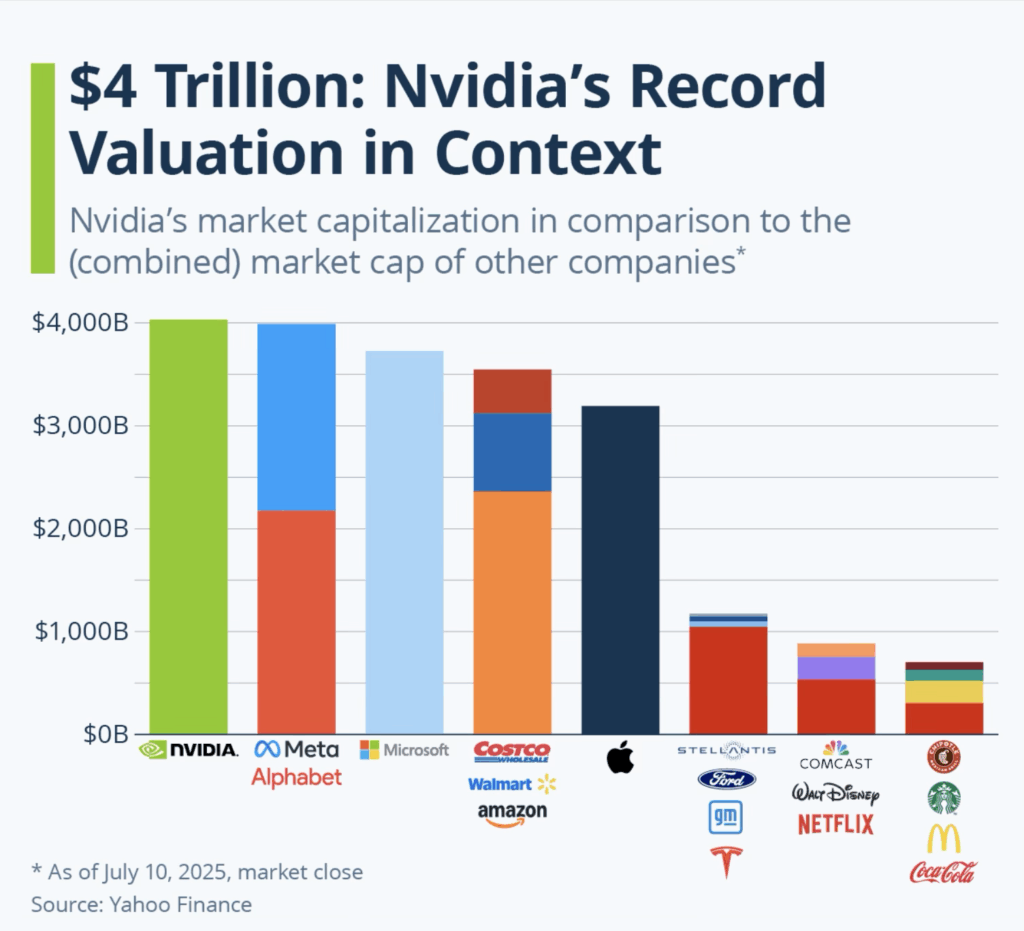
The historical evidence from previous periods of investor exuberance due to technological or regulatory developments is not kind to the pioneers of these developments. For instance, the businesses laying fiber optic cables for the internet revolution in the late 1990s did not benefit from the expansion of internet usage. As a matter of fact, investors were wiped out. Instead, it was the users of internet traffic that benefited the most. Think of META (Facebook, Instagram), Alphabet (GOOGL), AMAZON, and NETFLIX. Similarly, during the 2014 shale oil revolution, many oil exploration companies went out of business due to increased oil supply and the subsequent drop in oil price. Hopeful investors chasing the new oil technology got wiped out yet again. “Scratch off” chasers in 2019 also got excited about the potential legalization of cannabis in the U.S. and in no time, a bunch of cannabis companies were listed on stock exchanges and attracted a substantial amount of investment funds. Six years later, cannabis is widely used in most U.S. states, yet most of the cannabis businesses never made a profit, and yes, investors also lost a bunch of money on these scratch offs.
**Learning from history allows us to be more careful when signs of exuberance emerge in the market. We become more conservative with our capital allocation by holding more cash, more Treasury bonds, and solid companies with good fundamentals and reasonable valuations. **
The impatient investors choose to ignore these signs of exuberance and continue to go full-on risk. They choose to ignore the extreme valuations and the record-high margin debt. They fall victim to the relentless push of hope from Wall Street. For example, the big investment firms have created more than 4,300 ETFs (exchange-traded funds), but there are only 4,200 publicly traded companies in the US. Some of these “opportunities” are leveraged ETFs on a single stock, offering 2X or 3X long or short the performance of a stock. This is pure gambling offered as “investment opportunities”. Buyers be aware!
On a related note, it was quite amusing to read last week that BlackRock, the largest investment firm managing a staggering $11 Trillion, expressed concern about stock market valuations. However, they found value in “pockets of high yield markets.” In other words, BlackRock was searching for opportunities in junk bonds. These bonds are called “junk” for a reason—It’s akin to finding some unspoiled food items in the dumpster behind the grocery store, where food items deemed unsuitable for human consumption are discarded!
The impatient investors are confident that a full risk-on attitude is currently correct because they believe Jerome Powell and the Federal Reserve System (FED) will bail them out with interest rate cuts. While it’s true that Powell opened the door for rate cuts during his Jackson Hole speech on August 22nd, the FED has become aware that the labor market doesn’t seem as resilient as they had anticipated. This is concerning because we’ve been worried about the health of the labor market for over a year now, and we have little faith in the ability of the Bureau of Labor Statistics (BLS) “Death and Birth” model to accurately estimate job data. Nevertheless, with the current unemployment rate at a low 4.2%, the inflation rate at 2.9% (Personal Consumer Expenditures) exceeding the FED’s goal of 2%, and the Atlanta FED forecasting a 3rd quarter GDP growth rate of 3.5% (implying a 2% annualized growth rate for the US economy), it seems questionable whether rate cuts are the appropriate monetary policy at this juncture.
In fact, while investors are welcoming the news of possible rate cuts, it is possible that rushing rate cuts, given the still-strong economic data, may become a cause of investor concern. What does the Fed see that we don’t? What suggests the US economy is in worse shape than it appears, and it needs such rate cuts?
Stock markets tend to respond well to rate cuts if the economy is still holding up, but responds poorly if the rate cuts are due to an imminent recession. Long-term bonds also tend to do very well in an environment of rate cuts, but only if the cuts are not expected to lead to higher inflation. At this point, the markets’ reaction to possible rate cuts depends on the rationale offered by the FED for the cuts.
Finally, we must also consider market seasonality. The next six weeks of the calendar are typically prone to air pockets (market corrections of varying sizes). Therefore, we recommend a more conservative portfolio positioning until mid-October. After that, we suggest a more aggressive positioning for the last two months of the year, as seasonality is typically more favorable to markets during that period.
We are always available to answer your questions and offer our insights about the economy and the markets.
Stay Fierce!